Flagship · AI / Healthcare
Seeing the crunch before it hits
An agentic AI assistant that helps hospital patient-flow coordinators see a capacity crunch before it happens, weigh the tradeoff, and act, without handing the decision to a black box.
Flagship · AI / Healthcare
An agentic AI assistant that helps hospital patient-flow coordinators see a capacity crunch before it happens, weigh the tradeoff, and act, without handing the decision to a black box.
Context
Patient-flow coordinators keep a hospital moving. They watch emergency department intake, bed capacity, and surgical schedules, and they make constant calls about where patients should go and when. When a spike hits and the current plan runs short, the cost is real: longer waits, backed-up beds, and pressure that cascades across departments.
The information they need to make those calls is scattered and lagging. By the time a problem is obvious, it is already happening. The coordinator is reacting, not planning.
Principle
Iris is designed around a single principle: the AI does the forecasting and the heavy analysis, but the human makes the decision. Every recommendation comes with its reasoning and its tradeoff laid bare, so the coordinator stays in control and accountable.
The core loop is four steps: forecast the crunch, propose a scenario, show the tradeoff, then deploy and monitor, with a clear path to revert.
One recommendation. Its reasoning. The tradeoff, in full. The coordinator decides.
The flow, screen by screen
01
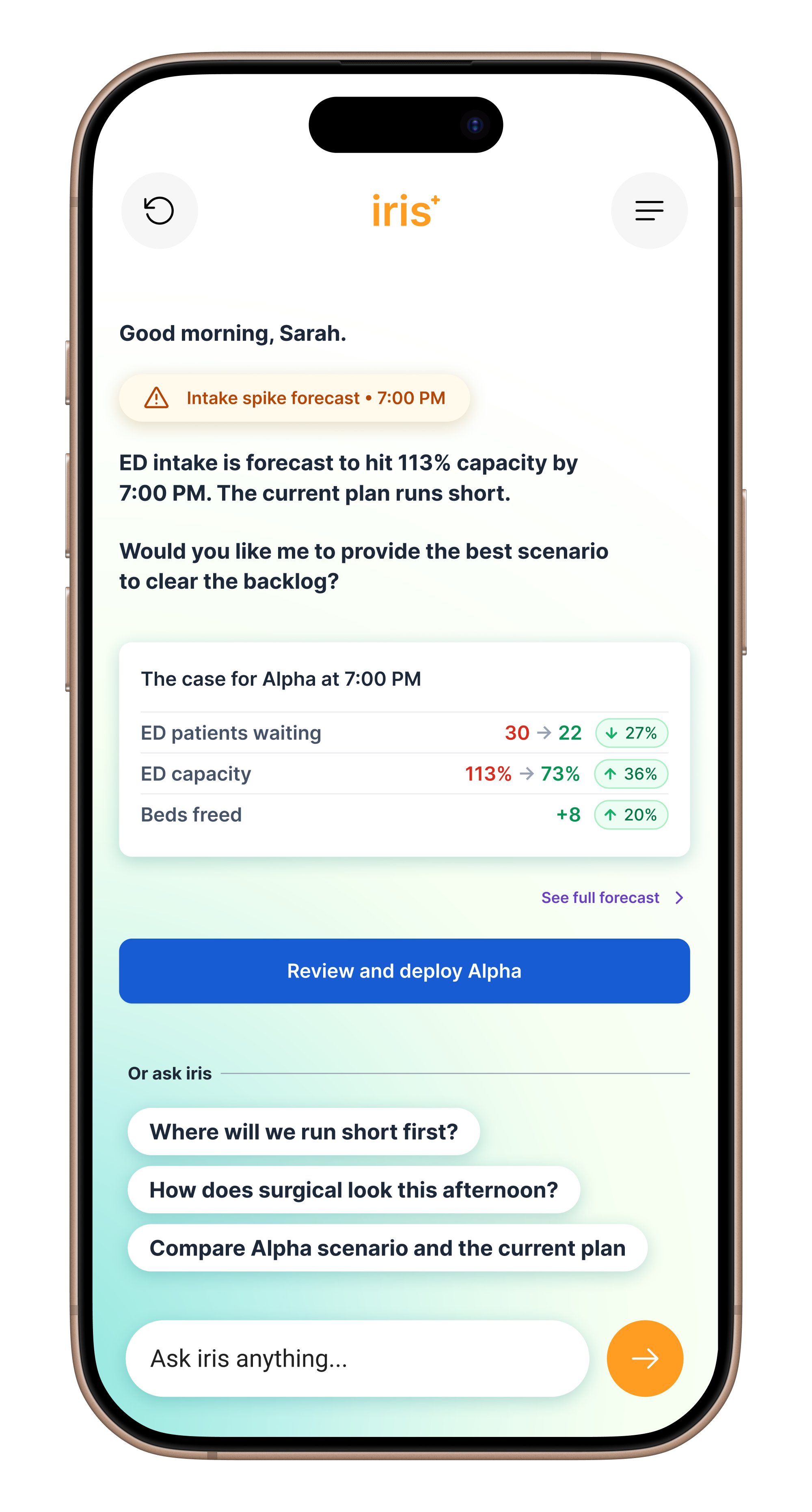
Iris opens with a plain-language briefing. ED intake is forecast to hit 113% capacity by 7:00 PM, and the current plan runs short. Instead of burying that in a dashboard, Iris states it and offers to help, then asks whether the coordinator wants the best scenario to clear the backlog.
02
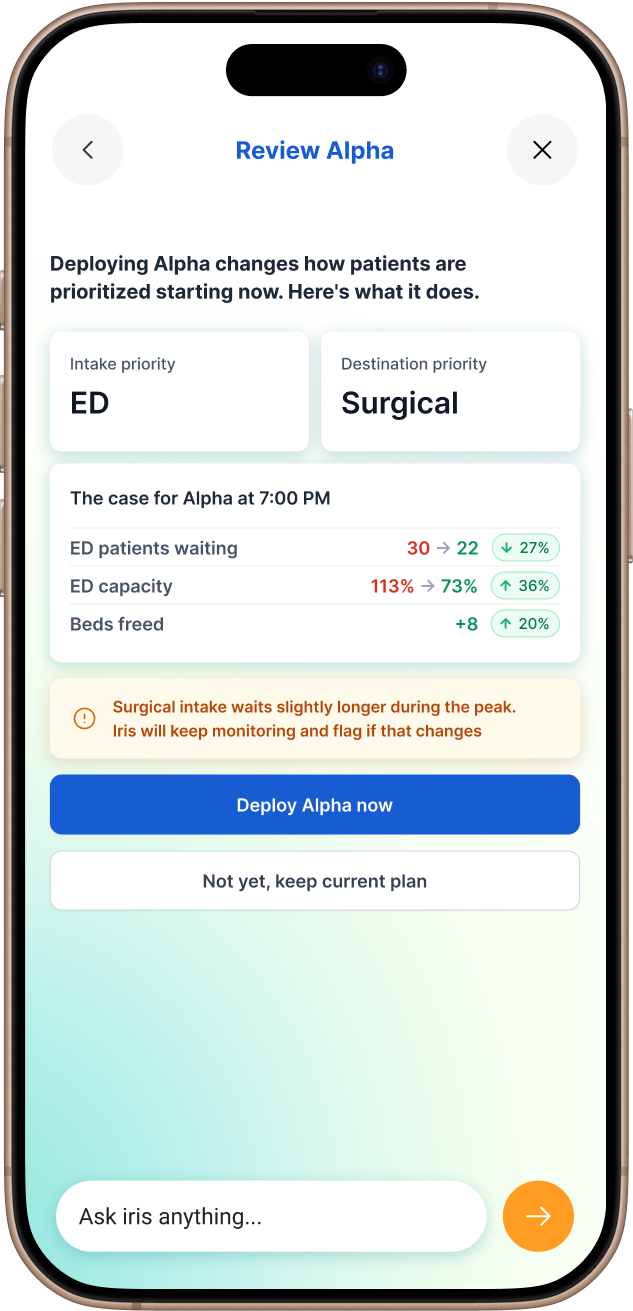
The Alpha scenario prioritizes ED intake and routes toward surgical destinations. Iris shows exactly what changes: ED patients waiting drop from 30 to 22, capacity eases from 113% to 73%, eight beds freed. It also names the cost honestly, surgical intake waits slightly longer during the peak. Nothing is hidden to make the recommendation look better than it is.
03
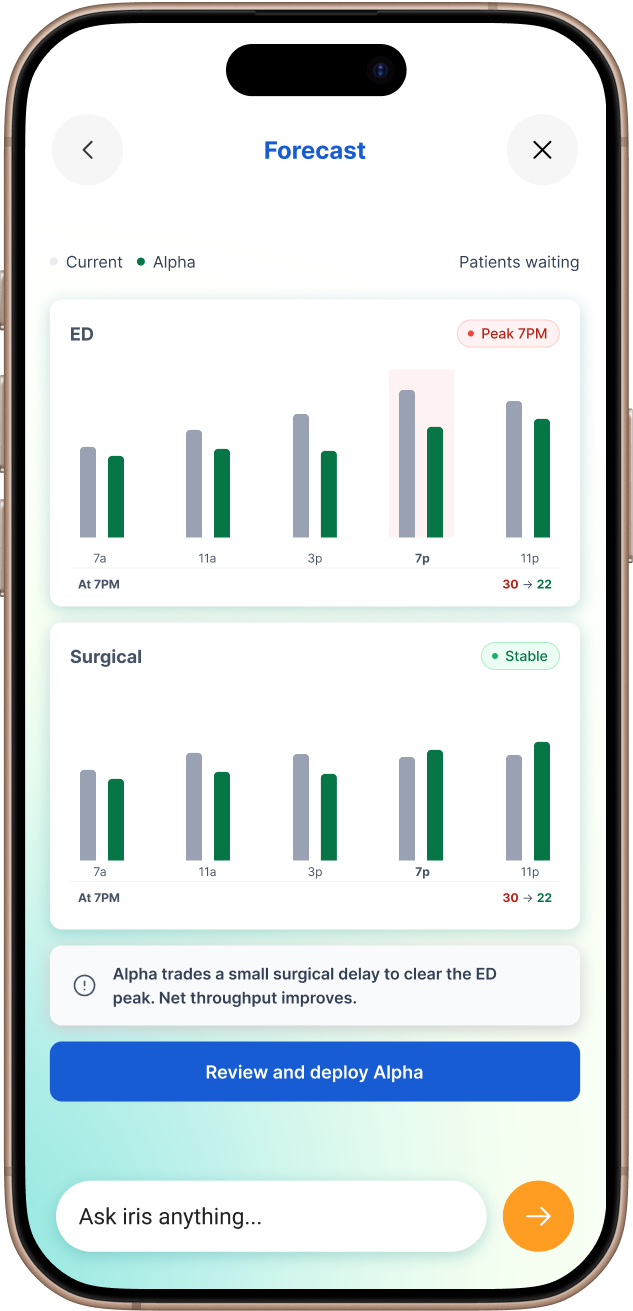
For coordinators who want to verify before they act, the full forecast compares the current plan against Alpha across the day, for both ED and surgical. The 7:00 PM peak is highlighted. Alpha trades a small surgical delay to clear the ED peak, and net throughput improves. The chart makes that legible at a glance.
04
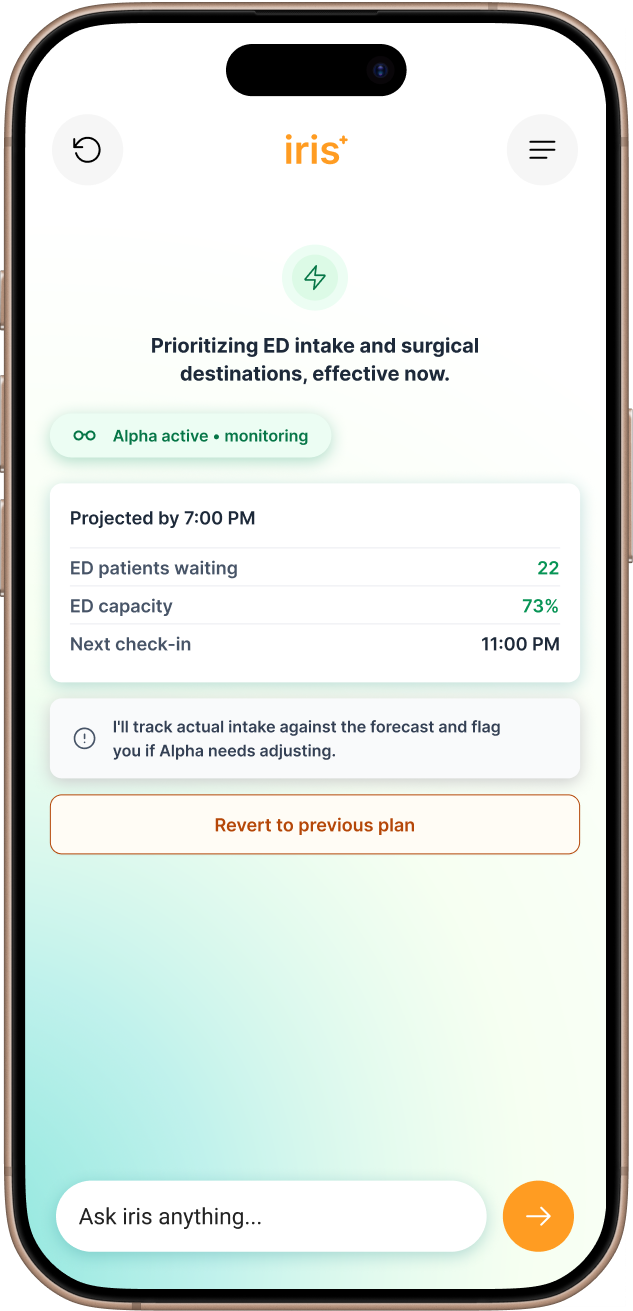
Once deployed, Iris does not go quiet. It tracks actual intake against the forecast and flags the coordinator if Alpha needs adjusting. A revert path stays one tap away. The coordinator is never locked into a decision the moment conditions change.
05
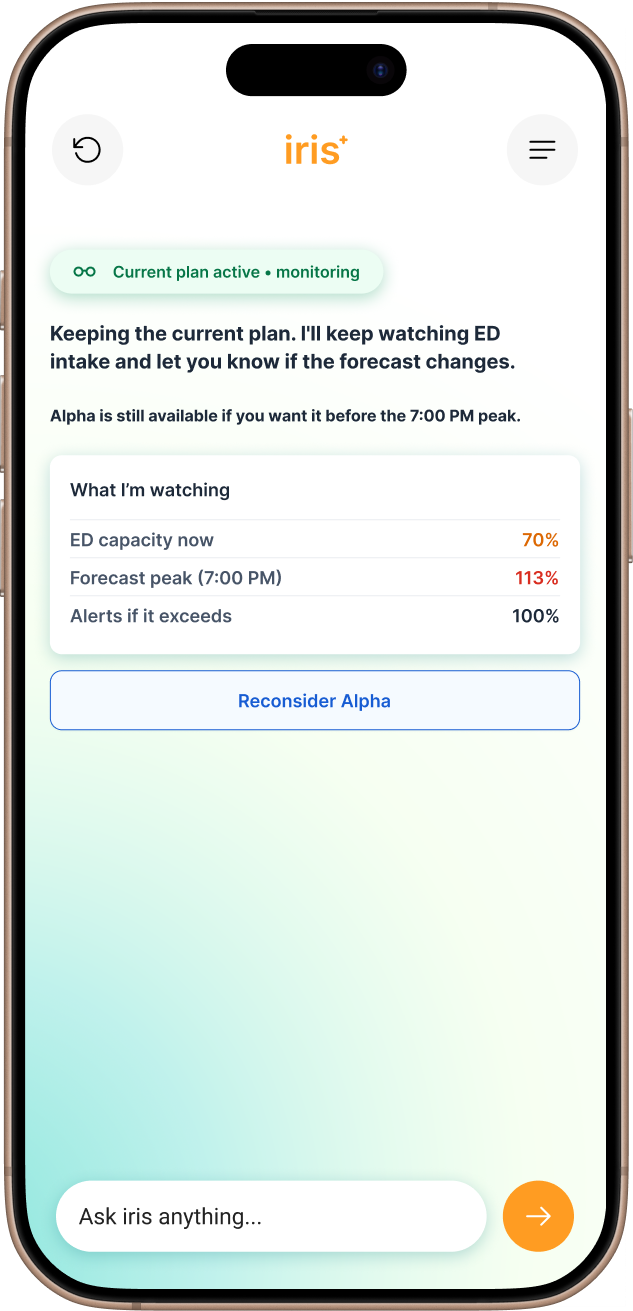
Declining Alpha is a first-class path, not a dead end. Iris keeps the current plan, states what it is watching, ED capacity now, the forecast peak, the alert threshold, and leaves Alpha available if the coordinator wants it before the peak. Saying no is always safe.
Principles
Every recommendation is paired with the why and the cost. Trust in an agentic system comes from transparency, not confidence.
Iris speaks before it charts. The data is there for verification, but the coordinator never has to decode a dashboard to know what is happening.
Deploy, monitor, revert. Every action can be undone, which makes acting on a recommendation low-risk instead of high-stakes.
Iris never executes on its own. It informs and proposes; the coordinator decides. That boundary is the heart of the design.
Better calls, made sooner, when a hospital is under pressure.
Happy to talk through the research, the forecast model surface, and the decisions behind Iris in detail.
Get in touch